PLAN YOUR TREK · WHERE TO GO
Three countries share the mountain gorilla's range. Each offers a different experience, price and risk profile. Here's how to choose the right one for you.
Quick answer: Uganda's Bwindi Impenetrable Forest is the best place for most travelers, with around half the world's mountain gorillas, over 20 habituated families and permits from US$800. Rwanda's Volcanoes National Park is best for short trips and luxury, about three hours from Kigali, with permits at US$1,500. The DRC also has gorillas, but its gorilla parks are currently closed or in areas governments advise against all travel to, so we don't recommend it right now.
The forest is impossibly quiet. Then a branch snaps. A low rumble rolls through the undergrowth, and suddenly there he is: a silverback mountain gorilla, close enough that you can see the silver hairs catching the morning light, his dark eyes holding yours with an intelligence that stops you cold. For most travelers, a gorilla trek is the single most profound wildlife encounter of their lives.
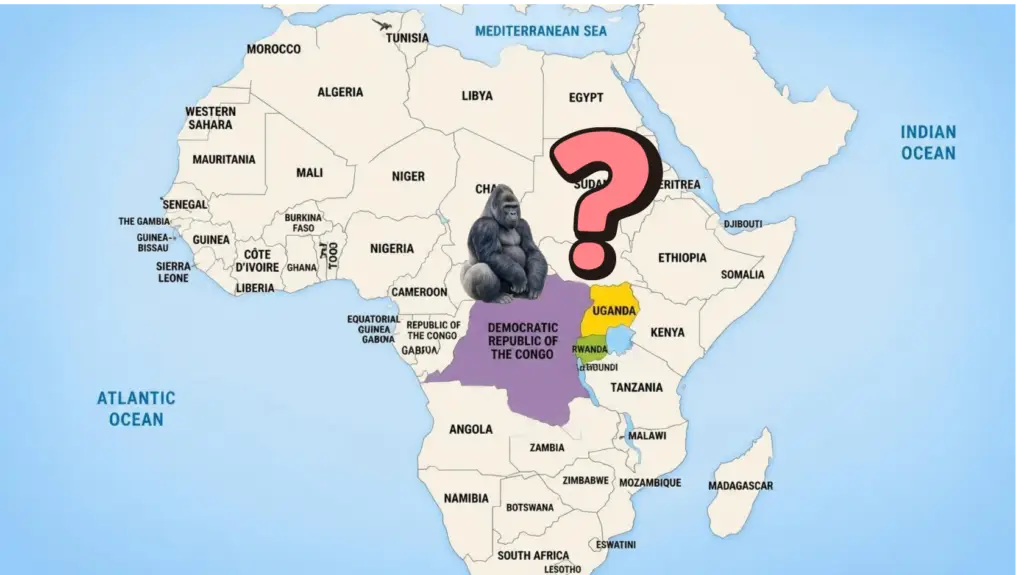
But before you can stand in that forest, you face a decision that shapes everything: where do you go? Three countries share the mountain gorilla's range: Uganda, Rwanda and the Democratic Republic of Congo. Each offers a fundamentally different experience, at a different price point, with a different risk profile. This guide breaks it all down so you can choose the destination that's right for you.
Mountain gorillas (Gorilla beringei beringei) are one of the rarest animals on Earth, and one of conservation's greatest success stories. The global population now exceeds 1,000 individuals, up from fewer than 700 just two decades ago. The Virunga Massif population, shared across Rwanda, Uganda and the DRC, has grown to around 604, while approximately 460 live in Uganda's Bwindi Impenetrable Forest.
They are the only great ape whose population is increasing. Yet they remain classified as Endangered on the IUCN Red List, and they have never survived in captivity. The only way to see a mountain gorilla is to go to them: in the wild, in the forest, on their terms.
Gorilla tourism is not just a travel experience. The permit fees you pay fund ranger salaries, anti-poaching patrols and community development programs that give local people a direct economic stake in the gorillas' survival. When you book a gorilla trek, you are actively contributing to their protection.
“To look into a gorilla's eye is to find your own soul looking back. In that quiet, breathless hour, the modern world falls away completely, leaving only a raw, spiritual connection with the wild.”
Uganda is home to roughly half the world's mountain gorilla population, and Bwindi Impenetrable National Park is the centrepiece of any gorilla trekking itinerary here. A UNESCO World Heritage Site, Bwindi is one of Africa's most biodiverse forests, with 120 mammal species, 350 bird species and more than 1,000 plant species packed into 128 square miles (331 square kilometers) of ancient Afromontane rainforest.
With over 20 habituated gorilla families and around 160 permits available daily, Uganda offers more choice and more availability than anywhere else on Earth.

Bwindi has four trekking sectors, Buhoma, Ruhija, Rushaga and Nkuringo, each with its own gorilla families, trailheads and lodges. Our Bwindi Impenetrable National Park guide compares the sectors in detail, along with the gorilla families in each one.
Smaller and less visited than Bwindi, Mgahinga sits on Uganda's border with Rwanda and the DRC. It is home to just one habituated gorilla family (eight permits per day) and also offers golden monkey trekking. The open volcanic terrain feels more like Rwanda's Volcanoes National Park than Bwindi's dense rainforest.
The Uganda Wildlife Authority (UWA) sets permit prices:
✓ Foreign non-residents: US$800
✓ Foreign non-residents in the low season (April, May and November 2026 and 2027): US$600
✓ Foreign residents: US$700
✓ East African citizens: UGX 300,000
UWA requires full payment at the time of booking, and permits are non-refundable, so travel insurance with a safari-specific clause is essential. See our full guide to gorilla permits and cost.
Rwanda's Volcanoes National Park protects the Rwandan side of the Virunga Massif, a chain of dormant volcanoes cloaked in bamboo and montane forest. It is where Dian Fossey founded the Karisoke Research Center in 1967 and spent nearly two decades studying mountain gorillas, and the park is now home to around a dozen habituated gorilla families.
Its biggest advantage is access. The park headquarters at Kinigi is about three hours by road from Kigali International Airport, so you can fly in, trek and be home within a few days. Each family can be visited by a maximum of eight people a day, and treks typically take from 30 minutes to four hours to reach the gorillas. The trails cross farmland, bamboo and open montane forest, so they are generally gentler than Bwindi's steep, tangled rainforest, although the altitude can still make for a tiring day.
Permits are issued by the Rwanda Development Board (RDB):
✓ International visitors: US$1,500 per person
✓ Minimum age: 15 years
✓ Time with the gorillas: one hour
That's nearly twice the price of a Uganda permit, which reflects Rwanda's deliberate high-value, low-impact approach to tourism. Rwanda has offered discounted permits in the low season when you combine Volcanoes with Nyungwe or Akagera national parks; ask us what's available for your dates. Permits often sell out months ahead for June to September, so book early.
✓ Golden monkey trekking in the bamboo forests of Volcanoes National Park
✓ Dian Fossey's grave at Karisoke, a demanding hike up Mount Bisoke's slopes
✓ The Ellen DeGeneres Campus of the Dian Fossey Gorilla Fund, near Kinigi
✓ Chimpanzee tracking and canopy walks in Nyungwe Forest
✓ Big Five game drives in Akagera National Park
✓ Relaxing on the shores of Lake Kivu
Rwanda suits you if: you're short on time, you'd like a gentler trek or you want to stay in one of Africa's finest luxury lodges. See our Rwanda gorilla trekking page.
The Democratic Republic of Congo has two gorilla parks, and on paper both are extraordinary.
Virunga National Park, founded in 1925, is Africa's oldest national park. It protects the Congolese slopes of the Virunga volcanoes and their mountain gorillas, as well as the famous overnight hike to the lava lake of Mount Nyiragongo.
Kahuzi-Biega National Park, near Bukavu, is one of the few places to see eastern lowland (Grauer's) gorillas, the largest gorilla subspecies on Earth. Permits here have historically been far cheaper than in Uganda or Rwanda, at around US$400.
Current situation: M23 rebels took Goma in January 2025 and Bukavu in February 2025. Virunga is closed to tourism, and Kahuzi-Biega lies in South Kivu, where there is no realistic tourism access. The UK Foreign Office advises against all travel to North and South Kivu, and the US rates the DRC “Level 4: Do Not Travel”. We don't currently offer gorilla treks in the DRC.
If seeing gorillas in the DRC is on your bucket list, keep an eye on official advice from the Congolese Institute for the Conservation of Nature (ICCN) and your government's travel advisories. In the meantime, the Virunga Massif's mountain gorillas move freely across the borders, and you can trek the same population from the Ugandan and Rwandan sides in Mgahinga and Volcanoes national parks.
✓ Uganda: the best value and the most choice. Permits from US$800, over 20 habituated families, wilder and often tougher trails, and the chance to add chimpanzees, golden monkeys or a second trek.
✓ Rwanda: the quickest and most luxurious. Permits at US$1,500, about three hours from Kigali, generally gentler treks and world-class lodges.
✗ DRC: not currently recommended. Its gorilla parks are closed or in areas under no-travel advice.
Still deciding? Our Uganda vs Rwanda guide compares the two side by side.
For most travelers, Uganda's Bwindi Impenetrable National Park: it has around half the world's mountain gorillas and permits from US$800, set by the Uganda Wildlife Authority. For a short trip, Rwanda's Volcanoes National Park is about three hours from Kigali, with permits at US$1,500 set by the Rwanda Development Board.
Not at the moment. Virunga National Park is closed to tourism, and the UK Foreign Office advises against all travel to North and South Kivu, where the DRC's gorilla parks are. Check the latest UK travel advice for the DRC before planning a trip.
Buhoma for first-timers, Rushaga for the most permit availability and the Gorilla Habituation Experience, Nkuringo for views and a tougher trek, and Ruhija for birdwatching. Our gorilla permits and cost guide explains the prices. Our Bwindi guide compares them in detail.
Yes. Many travelers fly into Kigali, trek in Rwanda's Volcanoes National Park, then cross into Uganda for Bwindi or Mgahinga. Our Uganda vs Rwanda guide explains how to combine them.
Permit prices are set by UWA and RDB and can change. DRC security information reflects UK and US government advice. Correct as of October 2026.
Tell us your dates, budget and fitness and we'll recommend the right park and check permit availability.
Inquire now